Legacy Application Modernization Services
Modernize. Optimize. Future-Proof Your Business.
Empower Your Business with Modern, Scalable Applications
Outdated software shouldn’t stand between you and your growth goals.
At Telkoware, we specialize in legacy application modernization services that transform old, rigid systems into secure, scalable, and high-performing platforms.
Whether your applications are slowing down productivity, draining IT budgets, or limiting integration with newer tools, our modernization experts can help you unlock agility and innovation.

Let’s modernize your legacy software & systems — without disrupting operations.
The Challenge: Outdated Systems, Modern Problems
Many small and mid-sized businesses still rely on legacy applications that were once innovative — but now hold them back.
Here’s what happens when your legacy software can’t keep up:
- Rising maintenance and licensing costs
- Security vulnerabilities and compliance risks
- Poor integration with cloud, AI, or mobile systems
- Outdated user experience frustrating employees and customers
- Inflexible architecture that slows innovation
What is considered a legacy application?
An application becomes legacy when maintaining, changing, securing or integrating it creates significant cost or risk.
A 15-year-old application that is well-supported, secure and easy to maintain may be less problematic than a five-year-old application built on abandoned libraries with poor documentation.
Common characteristics of legacy applications include unsupported frameworks, obsolete operating systems, tightly coupled architecture, outdated user interfaces, limited integrations, manual deployments, scarce developer expertise and little or no automated testing.
A useful way to think about legacy status is therefore not “How old is the software?” but “How difficult is it for the software to safely accommodate the next business requirement?”
| Feature | Legacy Systems | Modern Applications |
| Speed & Performance | Slow response, frequent downtime | Fast, optimized for high traffic |
| Maintenance Cost | High, resource-heavy | Lower due to automation and scalability |
| Security | Vulnerable to breaches | Regular updates and encryption standards |
| Integration | Limited | API-driven, connects easily to modern tools |
| Scalability | Fixed capacity | Cloud-native and elastic |
Why should businesses modernize legacy applications that still work?
A legacy application may continue working, while simultaneously becoming harder to patch, integrate, modify and support. Businesses often discover the problem only when a critical change becomes urgent; for example, a security requirement, operating-system upgrade, integration request or departure of a key developer.
According to the U.S. Government Accountability Office, approximately 80% of reported U.S. federal IT spending has historically gone toward operating and maintaining existing systems, including aging legacy systems that GAO says can create higher costs and cybersecurity vulnerabilities.
The best time to modernize is therefore usually before the application forces the decision through a failure, security incident or unsupported dependency.
The Cost of Doing Nothing
Every year your systems stay outdated, you face:
- Reduced productivity due to inefficiency
- Higher operational costs from manual workarounds
- Increased cybersecurity risks from unpatched vulnerabilities
- Lost competitiveness as digital-first competitors surge ahead
According to McKinsey, businesses that invest in modernization can reduce IT costs by up to 30% and improve speed-to-market by 50%.
Don’t let outdated systems slow your growth.
What is Legacy Application Modernization?
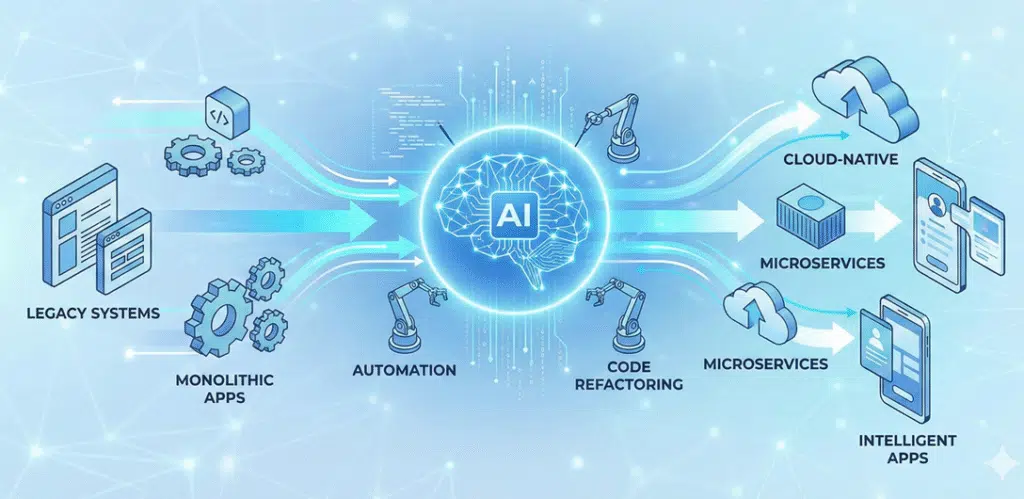
Legacy application modernization is the process of improving an outdated software application to align with current business needs, technologies, and security standards; without disrupting core operations.
Telkoware’s approach focuses on incremental transformation — improving performance, scalability, and security while ensuring business continuity.
Modernization can involve upgrading programming languages and frameworks, improving the user interface, moving infrastructure, refactoring code, modernizing databases, introducing APIs, improving cybersecurity, automating deployments or integrating cloud and AI capabilities.
The important distinction is that modernization is not synonymous with rewriting. A good modernization strategy preserves valuable business logic while replacing the technology that creates cost, risk or limitations.
Google Cloud similarly describes modernization as a spectrum that can include rehosting, replatforming, refactoring, rebuilding and replacing.
At Telkoware, our objective is not to “make the software newer.” It is to make the application easier to update and safer to manage as the business changes.
Five Main Legacy Software Modernization Strategies
| Approach | Description | Ideal For | Example Benefit |
| Rehosting | Moving applications to modern infrastructure with minimal code changes (e.g., cloud). Often referred to as ‘lift and shift’ | Stable systems needing better performance | 30–40% cost reduction |
| Replatforming | Migrating to a new runtime or changing platform components(e.g., from .NET to .NET Core) | Systems needing scalability | Easier integration |
| Refactoring | Optimizing application code or architecture without changing functionality | Code-heavy apps | Better maintainability |
| Rebuilding | Rewriting the app from scratch with modern tech, while preserving current business logic. | Severely outdated systems | Future-proof architecture |
| Replacing | Replacing with off-the-shelf or SaaS solutions available in the market | Non-core legacy apps | Faster deployment |
The correct strategy is the least disruptive approach that removes the business constraint you are trying to solve.
Telkoware’s Application Modernization Framework
At Telkoware, we follow a structured, risk-free legacy application modernization approach tailored for organizations.

o Deep-dive audit of existing systems, infrastructure, and pain points.
o Cost-benefit and ROI analysis.

o Create a phased modernization plan
o Define tech stack, migration path, and KPIs
o Upgrade backend, UI/UX, and integrations
o Implement APIs, microservices, or cloud migration
o Regression, load, and security testing
o QA across browsers, devices, and operating systems

o Smooth transition with zero data loss
o Ongoing performance tuning and monitoring
Request your customized legacy software modernization roadmap today.
Software Modernization Technologies We Use

Frontend Frameworks
• React JS
• Angular
• Vue JS
• Next JS
• Laravel
Backend Technologies
• Node JS
• ASP.NET Core
• Python
• PHP
• Ruby on Rails

Databases
• SQL Server
• PostgreSQL
• MySQL
• MongoDB
Cloud & DevOps
• Microsoft Azure
• Amazon Web Services (AWS)
• Google Cloud Platform (GCP)
• Docker, Kubernetes, CI/CD pipelines
Let’s select the right technology stack for your legacy app modernization journey.
What are the Business Benefits of Legacy App Modernization?
Modernizing your software delivers measurable business outcomes:
- Reduce operational costs — up to 40% savings on maintenance
- Enhance security — compliance-ready, secure-by-design
- Boost performance & speed — faster load times, better user experience
- Improve scalability — ready for growth, integrations, and cloud adoption
- Empower teams — seamless collaboration and automation
- Enable innovation — connect with AI, analytics, and IoT
📈 After legacy system modernization, organizations often see a 25–50% increase in operational efficiency.
Can we modernize only the parts of application that are causing problems?
Yes—and in many cases, component-level modernization is preferable to treating the entire application as one indivisible project.
For example, a business might retain its database and core transaction engine while replacing an outdated user interface, authentication system or reporting module.
For a recent ERP project, Telkoware kept most functionality unchanged while adding APIs that allowed it to integrate with other platforms.
| Model | Ideal For | What’s Included | Example |
| Full Rebuild | Systems beyond repair | UI/UX redesign, backend rebuild, full migration | ERP modernization |
| Partial Modernization | Core system is functional | API integration, microservices, UI upgrade | CRM upgrade |
| Cloud Migration | On-premises systems | Cloud hosting, data migration | Inventory platform on Azure |
Let’s explore which option best fits your business goals.
Our Case Studies
Case Study 1: Canadian Manufacturing Firm Cuts IT Costs by 45%
Before:
A mid-sized Ontario manufacturer ran a 12-year-old production planning system built on outdated .NET and SQL architecture. Downtime and manual data exports cost 15 hours per week.
After Modernization:
Telkoware refactored the backend, migrated it to Azure, and built a React-based dashboard.
Results:
- 45% reduction in IT maintenance costs
- Reports generated 80% faster
- System uptime improved to 99.8%
Case Study 2: Healthcare Clinic Group Improves Data Security & Compliance
Before:
A Toronto-based clinic chain used a legacy Access database for patient scheduling — slow, error-prone, and non-compliant with PHIPA standards.
After Modernization:
Telkoware rebuilt the system with a secure web interface using Angular and Node JS, integrated with encrypted Azure storage.
Results:
- 100% PHIPA compliance
- Zero data loss during migration
- 60% faster appointment scheduling
Case Study 3: Logistics Company Enhances Efficiency by 50%
Before:
A transportation company used a desktop-based dispatch app that couldn’t integrate with GPS or mobile tracking.
After Modernization:
Telkoware replatformed it to a responsive web app using ASP.NET Core and React JS.
Results:
- Dispatch processing time cut by 50%
- Real-time GPS integration enabled
- Maintenance costs reduced by 35%
Case Study 4: Retail Chain Adopts Cloud for Scalability
Before:
A Canadian retailer used an outdated POS and inventory system hosted on-premises.
After Modernization:
Migrated to AWS Cloud with microservices architecture.
Results:
- 99.9% uptime
- Cloud scalability for seasonal demand
- 30% faster inventory updates
Case Study 5: Nonprofit Streamlines Donor Management
Before:
A nonprofit organization relied on a legacy CRM with limited reporting and no mobile access.
After Modernization:
Telkoware rebuilt the CRM with Vue JS and Node JS, adding analytics dashboards and cloud hosting.
Results:
- 2x increase in donor engagement
- 70% faster reporting
- Zero downtime during transition
Ready to Modernize Your Legacy Application?
FAQs – Legacy Application Modernization
What are the common signs that a legacy application is becoming a business risk?
A legacy application becomes a business risk when problems inside the software begin affecting revenue, productivity, security, customer experience or the company’s ability to change.
Common warning signs include:
- Unsupported software or operating systems
- Recurring outages or performance problems
- Growing maintenance costs
- Dependence on one developer who understands the system
- Difficulty integrating with modern applications
- Manual data entry between systems
- Slow delivery of new features
- Security or audit findings
- Limited monitoring and logging
- Employees relying on manual process to work around the application
Telkoware’s free modernization assessment can review your legacy software and identify all possible risks of continuing with the legacy application.
How do I know if my application needs modernization?
You likely need modernization if your software:
- Takes too long to update or deploy changes (long release cycles)
- Frequently crashes or requires manual fixes
- Can’t integrate with new apps or cloud tools
- Has security vulnerabilities or outdated libraries
- Performance is slow
- Has manual workarounds outside the application
- Costs more to maintain than to innovate
Telkoware recently modernized a supply chain application, which required weeks of analysis because nobody knew what else might break. After modernization, now it only takes a few days to analyze and implement the changes.
Microsoft recommends assessing both technical and business signals—including end-of-support dependencies, security requirements, scalability limitations and modernization opportunities—before selecting an upgrade strategy.
Telkoware’s Free Modernization Readiness Assessment can help you identify if the application needs modernization or not.
What is the difference between legacy application modernization and digital transformation?
Application modernization improves the technology foundation; digital transformation changes how the business operates using technology.
Modernizing an application might involve upgrading its framework, moving infrastructure, adding APIs, improving security or redesigning its architecture.
Digital transformation is broader. It might redesign an entire customer journey, automate an operational process, introduce a new digital business model or connect previously disconnected departments.
The two often reinforce each other. Modernizing a legacy application may remove the technical barriers preventing a larger digital transformation initiative.
A useful distinction is:
- Modernization asks: “How should this application evolve?”
- Digital transformation asks: “How should this business process evolve?”
At Telkoware, we answer the second question before deciding how far to go with the first.
Should I modernize, replace or completely rebuild my legacy application?
The right choice depends on how much business value exists in the current application versus how much technical constraint exists in its implementation.
- Modernization is usually appropriate when the application’s core business logic remains valuable but its technology needs improvement.
- Replacement may be better when a mature SaaS or commercial product already handles what the custom application does.
- Rebuild becomes more reasonable when the existing architecture or codebase is so constrained that preserving it would cost more than recreating the entire application from scratch.
Telkoware can perform a free modernization assessment and provide a recommendation based on multiple factors, including business differentiation, code quality, dependencies, data, integrations, security, maintainability and migration risk.
Can a legacy application be modernized without rebuilding it from scratch?
Yes. Many legacy applications can be modernized incrementally while retaining significant portions of the existing system.
Possible approaches include upgrading the framework, modernizing the frontend, introducing APIs, replacing individual modules, moving the database, improving authentication, containerizing the application or gradually refactoring problematic areas.
This approach can lower project risk because the organization does not need to reproduce every capability at once.
A useful modernization principle is:
Preserve what differentiates the business. Replace what constrains it.
Incremental modernization also allows new and old components to operate together while functionality gradually moves to the modern architecture.
For complex production applications, even Microsoft recommends incremental migration in situations where a complete framework migration would otherwise introduce substantial technical and operational risk.
Can a legacy application be modernized without disrupting business operations?
Modernization can be planned in such a way that the existing application continues operating throughout the project.
Techniques may include parallel environments, incremental module replacement, API routing, database synchronization, feature flags, staged releases and carefully planned cutovers.
Telkoware team completed multiple modernization projects with zero downtime, ensuring that there isn’t any business interruption.
Before production migration, critical workflows should be tested, data should be reconciled, rollback procedures should be validated and users should understand the changes.
For particularly critical systems, the old and modernized environments may operate simultaneously for a defined period, while users are gradually migrated from old to new system.
How long does legacy app modernization take?
The timeline depends on application complexity, dependencies, documentation, test coverage, data migration, integrations, modernization strategy and business availability for validation. Here are some rough estimates:
- Small apps: 2-4 weeks
- Mid-sized systems: 4–8 weeks
- Enterprise-grade solutions: 8-16 weeks
At Telkoware, we create a phased roadmap that ensures minimal disruption to your daily operations while maintaining transparency on progress and milestones.
A good modernization roadmap should therefore identify opportunities to deliver measurable improvements early rather than forcing the business to wait until a large “big bang” launch.
Can legacy application modernization be done with a limited budget?
Yes. Modernization does not have to be an all-or-nothing capital project.
Organizations with limited budgets can begin by addressing the highest-risk or highest-cost areas first.
Examples include upgrading an unsupported framework, introducing automated backups and deployment, modernizing authentication, adding APIs, replacing one problematic workflow or creating automated tests around critical business logic.
The key is to create a modernization roadmap rather than a collection of unrelated fixes.
A limited budget becomes much more effective when each improvement is designed to make the next modernization step easier.
Telkoware offers the most competitive pricing in North America, allowing companies to modernize legacy applications with a limited budget.
Is it cheaper to modernize an existing application or build a new one?
Neither option is automatically cheaper; the correct comparison is total lifecycle cost, not just development cost.
- Modernization can be economical when the application contains valuable business logic, stable data structures and functionality worth preserving.
- Rebuilding becomes more attractive when the architecture is fundamentally constrained or a large portion of the existing functionality is no longer needed.
- Replacement may be cheaper still if a commercial platform already meets the requirements.
A new application’s development estimate also tells only part of the story. Businesses must consider data migration, integration redevelopment, user training, operational transition and the risk of recreating undocumented functionality.
The cheapest system to build is therefore not always the cheapest system to successfully adopt and operate.
Telkoware can provide pricing proposals with total lifecycle cost for both modernization and re-build, so you can compare and decide.
How can a business calculate the ROI of legacy application modernization?
Modernization ROI should measure both new business value and the cost that the organization no longer has to carry.
Telkoware’s practical model to calculate ROI is:
ROI = (avoided legacy costs + productivity gains + new business value + quantified risk reduction − new operating costs) ÷ modernization investment
Avoided costs may include infrastructure, licenses, specialized support, recurring incidents and manual processes.
Productivity gains can include faster workflows, fewer errors and faster software releases.
Modernization can also create revenue opportunities—for example, enabling eCommerce, customer self-service, new integrations or AI functionality that the legacy architecture previously prevented.
One overlooked component is option value: a system that becomes easier to change allows the business to respond faster to future opportunities whose exact financial value may not yet be known.
Can modernization reduce software maintenance and support costs?
Yes. Modernization can reduce recurring costs when it eliminates obsolete infrastructure, specialized support requirements, fragile deployments and unnecessary operational complexity.
Savings may come from moving to managed services, eliminating expensive licenses, consolidating systems, automating deployments, reducing production incidents or making the application maintainable by a broader developer talent pool.
AWS notes that replatforming can reduce management overhead and, in appropriate situations, infrastructure or licensing costs without requiring a complete application rewrite.
However, cloud migration alone does not guarantee lower cost. Poor architecture can simply transfer inefficiency from an internal server to a cloud bill.
Modernization should therefore target the drivers of maintenance cost, not merely change where the application is hosted.
What is included in a legacy application modernization assessment?
A modernization assessment should establish what the application does, where its risks and dependencies are, and which modernization strategy creates the best business outcome.
Telkoware conducts a detailed assessment and examines:
- application architecture and source code
- programming languages and frameworks
- databases
- infrastructure
- integrations and APIs
- third-party dependencies
- cybersecurity
- performance and scalability
- deployment processes
- automated test coverage
- critical business workflows
- documentation
- support status and technical debt
- modernization options, risks and estimated effort.
Telkoware does not simply provides a list of technical problems. We provide a prioritized modernization roadmap.
How do you determine which parts of an application should be modernized first?
Start with the components where business importance, technical risk and frequency of change intersect.
The oldest component is not necessarily the best starting point.
A practical prioritization at Telkoware considers:
Business criticality × technical risk × change frequency × dependency impact
For example, an aging reporting module used once per year may deserve less urgency than an order-processing module that developers modify every month.
Security vulnerabilities and unsupported technologies may increase priority further.
It can also be valuable to modernize a “dependency bottleneck”—a component whose improvement makes several later modernization initiatives easier.
The first phase should therefore create momentum and risk reduction, not simply tackle whichever code happens to be oldest.
As part of modernization readiness assessment, Telkoware can provide a prioritized list of modernization phases.
Can legacy applications be migrated to Microsoft Azure, AWS or GCP?
Yes. Many legacy applications can be migrated to Microsoft Azure or AWS, but the appropriate cloud service should be selected after assessing the application.
Possible targets include virtual machines, managed databases, application hosting platforms, containers, serverless services and cloud-native architectures.
- Microsoft provides Azure Migrate application and code assessment capabilities for identifying compatibility issues and modernization opportunities in .NET applications.
- AWS similarly supports strategies ranging from rehosting and replatforming to deeper refactoring.
The right approach should not begin with “Which Azure/AWS service should we use?”
It should begin with “What business and technical constraints does the current application have?”
The cloud architecture should follow that answer.
Can we modernize the frontend without replacing the existing backend?
Yes. A modern web interface can often be introduced while retaining the existing backend and database.
An API or service layer can sit between the modern frontend and legacy business logic, allowing technologies such as React, Angular or Vue to provide a new user experience without immediately replacing the entire application.
This can be particularly useful when users dislike the interface but the underlying business logic remains stable.
It also creates a natural path toward incremental backend modernization later.
However, a new frontend cannot solve every backend limitation. Slow queries, security weaknesses and tightly coupled business logic may still need attention.
Frontend modernization should therefore be treated as one modernization layer—not a cosmetic replacement that hides unresolved technical risk.
Can a desktop application be modernized into a web-based application?
Yes. Many Windows and desktop applications can be transformed into browser-based applications accessible from laptops, tablets and other devices.
Existing business rules, databases and portions of backend code may sometimes be reused, while the user interface and application architecture are redesigned for the web.
The assessment should identify desktop-specific assumptions such as local file access, printers, scanners, serial devices, offline operation or Windows-specific APIs.
These functions may require new browser-compatible or service-based approaches.
Moving to the web can simplify deployment because users no longer need individual software installations and updates.
The project should not simply recreate every desktop screen in a browser. It is also an opportunity to simplify workflows that may have been designed around technical limitations that no longer exist.
Can we keep our existing database while modernizing the application?
Yes. An existing database can often remain in place while other parts of the application are modernized.
This can significantly reduce migration risk when the database is stable, supported and contains years of business-critical information.
A new application layer or front-end User Interface can initially connect to the existing database while deeper data modernization happens later.
However, the database should still be assessed for unsupported versions, licensing costs, performance problems, duplicated data, tightly coupled schemas and excessive business logic inside stored procedures.
Sometimes the database is quietly the largest source of technical debt in the application.
The decision should therefore be based on database health—not simply convenience.
A good modernization strategy can preserve the data while progressively reducing the application’s dependence on legacy database structures.
As part of Migration Readiness Assessment, Telkoware will also review the database and advise on the health and technical debt present in it.
Can APIs be added to a legacy application?
Yes. API enablement is one of the most effective ways to extend the useful life of a legacy application without rebuilding it. Infact, on a recent modernization project of inventory management system for a manufacturing company, Telkoware started with new REST APIs, so it can be integrated with other systems.
An API layer can expose selected functionality to mobile apps, customer portals, eCommerce platforms, CRM systems, cloud services and other applications.
Where modifying the legacy code is risky, an adapter or façade layer can sometimes provide APIs around existing business functions.
The important principle is to expose business capabilities, not simply open direct access to legacy database tables.
Direct database integration can tightly couple new applications to old schemas and create another generation of technical debt.
A well-designed API layer creates a controlled boundary around the legacy system and can eventually support gradual replacement of the components behind it.
Can legacy applications be integrated with modern CRM, ERP, accounting or cloud systems?
Yes. Legacy applications can often be connected to modern systems through APIs, middleware, message queues, integration platforms or custom connectors.
Examples include integrating a legacy operational application with Salesforce, HubSpot, Microsoft Dynamics, QuickBooks, cloud storage, payment systems, HRMS or modern ERP platforms.
The technical connection is only part of the problem.
Successful integration also requires decisions about data ownership.
For example, if customer details exist in both the legacy system and CRM, which platform becomes the authoritative source?
What happens when both records change simultaneously?
Without clearly defined source-of-truth and synchronization rules, integration can create inconsistent data even when the technical interfaces work perfectly.
Modern integration therefore requires data governance as well as connectivity.
Can legacy SOAP services be modernized into REST APIs?
Yes. SOAP services can be wrapped, progressively replaced or redesigned as REST APIs depending on their consumers and business requirements.
A low-risk first step may be introducing a REST façade while allowing existing SOAP integrations to continue operating.
New consumers use the modern API while older integrations remain functional until they can be migrated.
Over time, SOAP services can be retired.
However, modernization should not mechanically translate every SOAP operation into a REST endpoint.
REST APIs are typically better designed around business resources and use cases rather than reproducing old service contracts exactly.
The goal should therefore be to preserve compatibility where necessary while designing a cleaner contract for future integrations.
Are legacy applications a cybersecurity risk?
Legacy applications can become significant cybersecurity risks when their technologies are unsupported, difficult to patch or incompatible with modern security controls.
Age alone does not make an application insecure.
Risk increases when the application relies on end-of-life operating systems, vulnerable libraries, weak password mechanisms, outdated encryption, excessive privileges, unsupported frameworks or inadequate logging and monitoring. Legacy systems may also lack capabilities such as MFA, modern identity federation and automated vulnerability scanning.
CISA has warned that unsupported or end-of-life software creates unnecessary security risk, particularly when exposed to networks or the internet.
Modernization provides an opportunity to address these weaknesses systematically rather than continuing to layer temporary protections around increasingly difficult-to-secure software.
How does legacy application modernization improve security?
Modernization improves security by making the application patchable, observable and compatible with modern security controls.
Depending on the application, improvements may include supported frameworks, stronger encryption, modern authentication, MFA, role-based access, secrets management, API security, automated vulnerability scanning, centralized logging, secure deployment pipelines and improved backup and disaster recovery.
NIST emphasizes integrating security and risk management throughout the system lifecycle rather than treating cybersecurity as a separate activity after development.
This is an important modernization principle.
Security should not appear near the end of the project as a checklist.
Security requirements should influence the target architecture and become acceptance criteria for each modernization phase.
What happens if the programming language, framework or operating system is no longer supported?
The application may continue running, but the organization increasingly assumes responsibility for risks the original vendor is no longer addressing.
Unsupported technology may no longer receive security updates, compatibility fixes or technical assistance.
It can also become difficult to install on newer infrastructure or integrate with modern software.
Microsoft, for example, explicitly identifies end-of-support dependencies as a reason to consider upgrading .NET applications.
Immediate replacement is not always possible. Short-term controls might include network isolation, stronger monitoring, restricted access or compensating security measures.
However, these should support a planned migration—not justify indefinite use.
End-of-support dates should therefore be treated as business continuity milestones, not merely technical notifications for the IT department.
Can modern authentication, MFA and role-based access be added to a legacy application?
Yes. Many legacy applications can be integrated with modern identity platforms without requiring a full application rebuild.
Depending on the architecture, authentication can be modernized using standards such as OAuth or OpenID Connect and identity providers such as Microsoft Entra ID or other enterprise identity platforms.
MFA, single sign-on and role-based access can then be introduced around or within the existing application.
Some older authentication protocols may need replacement because they cannot consistently support modern controls.
OWASP specifically warns that legacy authentication endpoints can create MFA downgrade paths and recommends disabling legacy mechanisms that cannot enforce equivalent authentication requirements.
Authentication modernization can therefore provide meaningful security improvement even before deeper application modernization is complete.
Can AI be integrated into an existing legacy application?
Yes. AI capabilities can often be added to an existing application without rebuilding the entire system.
Modern AI platforms typically expose APIs that can be connected to legacy applications through an integration or service layer.
Potential capabilities include natural-language search, document analysis, data extraction, summarization, recommendations, intelligent workflows, customer support and internal knowledge assistants.
The legacy application’s data and business logic can remain in place while AI operates as an additional capability around it.
The more important question is not “Can we add AI?”
It is “Which decision, workflow or information bottleneck would AI materially improve?”
Starting with a clear business use case prevents organizations from spending money adding a chatbot to an application when the real opportunity may be automating a costly back-office process.
Telkoware team works closely with clients to map workflows, identify opportunities for AI integration, prepare business case with ROI analysis, and implement it.
How can AI improve an existing legacy business application?
AI can make a legacy application more useful by adding capabilities that were difficult or impractical when the original software was built.
Examples include:
- Asking questions about business data using natural language
- Extracting information from documents
- Summarizing records or case histories
- Classifying incoming requests
- Recommending next actions
- Detecting anomalies
- Generating drafts and reports
- Automating customer or employee support.
AI can sometimes create business value before a complete modernization project is finished.
However, AI works best when connected to reliable data and well-defined business processes.
If the underlying data is inconsistent or the business rule is unclear, AI can amplify that inconsistency.
For this reason, AI readiness is partly a data and process modernization problem—not simply an AI-model selection problem.
Can AI help automate manual processes currently handled by our legacy system?
Yes. AI can automate parts of workflows that previously required employees to read, interpret, classify, update or manually transfer information.
For example, AI can extract data from invoices, emails or forms; categorize requests; summarize documents; recommend actions; and initiate downstream workflows.
Traditional automation can then handle deterministic steps such as database updates, approvals, notifications and system integrations.
Combining AI with rule-based automation is often more reliable than asking AI to control an entire business process independently.
Before automating, Telkoware recommends documenting the current workflow, decision rules, exceptions and human approvals. If the documentation isn’t available, Telkoware can work with you to create it. This is extremely important because automating an unclear process does not eliminate inefficiency—it can automate the inconsistency faster.
Can AI help convert or refactor legacy application code?
Yes. AI can significantly accelerate code analysis, translation and refactoring, but AI-generated modernization still requires engineering review and testing.
GitHub documents the use of Copilot for understanding legacy code, suggesting refactors and even transforming legacy code into a modern implementation.
Microsoft’s current GitHub Copilot modernization tooling for .NET uses a structured process of assessment, planning, code transformation and validation.
AWS also offers generative-AI-assisted .NET modernization tooling.
However, Microsoft’s own documentation warns that generated upgrade suggestions are not guaranteed to follow best practices. So use AI to reduce modernization labour, but make sure to have Computer Engineers review and update it, since final accountability lies with them.
Can AI generate documentation and automated tests for legacy software?
Yes. AI is particularly useful for creating first-pass documentation and tests where a legacy application has poor coverage, but the results must be validated.
AI tools can explain functions, summarize modules, identify relationships, generate data-flow diagrams, create test plans and produce unit or integration test scaffolding.
GitHub’s legacy modernization guidance specifically demonstrates using Copilot to document legacy code, map data flows, create test plans and generate tests.
This can substantially accelerate the discovery phase.
However, generated tests can only validate behaviour they correctly understand.
Critical business rules should therefore be confirmed with existing application behaviour, production evidence and subject-matter experts.
AI can help reconstruct missing documentation, but business validation determines whether that reconstructed understanding is actually correct.
Can ASP.NET applications be modernized to ASP.NET Core?
Yes. ASP.NET Framework applications can be migrated to ASP.NET Core, either incrementally or through a more comprehensive upgrade.
The amount of work depends on application architecture, System.Web dependencies, authentication, session handling, third-party libraries, Web Forms usage and other framework-specific functionality.
Microsoft’s latest migration guidance states that moving most production ASP.NET Framework applications to ASP.NET Core is non-trivial and identifies incremental migration as the preferred approach for many production systems.
Microsoft now also provides AI-assisted GitHub Copilot modernization tooling that can assess dependencies, generate an upgrade plan and automate portions of the migration.
The modernization should still be validated through automated testing, performance testing and business-user acceptance before the legacy application is retired.
How to modernize an old, legacy PHP or Laravel application?
PHP modernization should begin with understanding application dependencies and business behaviour before upgrading the runtime or rewriting code.
The process followed at Telkoware is to:
- Identify the PHP version, libraries and frameworks
- Review security vulnerabilities
- Document dependencies
- Upgrade unsupported packages
- Refactor areas that prevent migration to a supported PHP version
- Modernize the application architecture and database
- Automate the deployment pipeline
- Re-design the front-end user experience, if required
For tightly coupled applications, it is often safer to modernize one complete workflow at a time rather than upgrading the entire codebase in one step.
A particularly useful principle for PHP modernization is to separate framework modernization from business-logic modernization.
Changing both simultaneously can make it difficult to determine whether defects came from the technical upgrade or from changed application behaviour.
How do you modernize a legacy Java application?
The process followed at Telkoware is to:
- Perform a detailed assessment to capture Java version, application server, frameworks, Maven or Gradle dependencies, databases, messaging systems, external integrations and proprietary libraries.
- Review security vulnerabilities
- Document dependencies
- Move to a supported Java version and upgrade frameworks
- Refactor areas that prevent migration to a supported Java version
- Modernize the application architecture and database
- Automate the deployment pipeline
- Re-design the front-end user experience, if required
- Modularizing the codebase, containerizing workloads or migrate the application to the cloud
AI tools are also increasingly capable of assisting Java modernization and code transformation, although generated changes still require review and testing.
GitHub now publishes dedicated guidance for AI-assisted Java application modernization.
How do I choose a legacy application modernization company?
Choose a modernization partner that is willing to understand your existing system before prescribing the replacement technology.
Strong providers like Telkoware should demonstrate expertise in both legacy and modern technologies and have a structured process for assessment, architecture, data migration, cybersecurity, testing, deployment and post-launch support.
Look for a company that can explain:
- What should be retained and why
- What should be replaced and why
- How business operations will continue during migration
- How information security will be maintained or improved
- How data will be protected
- How rollback will work
- How success will be measured
A credible modernization partner like Telkoware should have done similar projects in the past and use that valuable experience to ensure that your modernization initiative goes smoothly.
What questions should I ask a legacy application modernization provider?
Ask questions that reveal how the provider manages uncertainty and business risk—not simply which technologies they know.
Important questions include:
- How will you assess our existing application before recommending a solution?
- What parts of the current system could potentially be retained?
- How will you identify undocumented dependencies and business rules?
- How will you prevent data loss and business disruption
- What is your testing and rollback strategy?
- How do you decide between refactoring, rebuilding, replatforming and replacing?
- How will cybersecurity be improved during modernization?
- Who owns the source code and project assets?
- How will you estimate costs when requirements are uncertain?
- What documentation and knowledge transfer will we receive?
- What post-launch support is available?
- How will you measure whether the modernization succeeded?
The answers often reveal more about vendor’s experience and project risk than a vendor’s technology list.
Telkoware provides answers to these questions in its free modernization readiness assessment report.
Will I lose my existing data during legacy app modernization?
No. At Telkoware, data integrity is a top priority.
We use secure migration frameworks and perform multiple testing rounds to ensure your business data—customer records, transactions, files—remains 100% safe and accessible during and after modernization.
What technologies do you use for modernization?
We use a wide range of modern technologies, depending on your system architecture and goals:
- Frontend: React JS, Angular, Vue JS
- Backend: Node JS, ASP.NET Core, Python, PHP
- Database: SQL Server, PostgreSQL, MySQL, MongoDB
Cloud & DevOps: Azure, AWS, Google Cloud, Docker, Kubernetes
We recommend the most cost-effective stack based on your long-term scalability needs.
How much does legacy application modernization cost?
A simple modernization can cost $5,000, while a complex modernization can cost $25,000 or more.
Cost depends on code quality, architecture, technology stack, integrations, database complexity, security requirements, documentation, automated test coverage, migration strategy and downtime requirements.
- Rehosting / Replatforming: $5,000–$15,000
- Partial Modernization: $10,000–$25,000
- Full Rebuild: $20,000–$50,000+
For large or poorly understood applications, Telkoware recommends completing an assessment before finalizing the modernization scope and price. We provide transparent estimates with ROI projections before starting.
Can you modernize both web and mobile apps?
Yes. Telkoware offers application modernization services for both web and mobile platforms.
We modernize older mobile apps (built in frameworks like Ionic or early Android/iOS versions) using React Native or Flutter, ensuring a seamless multi-device experience.
Can modernization improve cybersecurity?
Absolutely. Legacy systems are often vulnerable to outdated security protocols.
Modernization strengthens your cybersecurity posture by:
- Updating to the latest encryption and authentication standards
- Closing known security gaps
- Enabling better data access control and audit trails
- Ensuring compliance with standards like GDPR, HIPAA, or PHIPA
Is cloud migration required for modernization?
Not necessarily. Cloud migration is one modernization option, not a requirement.
An on-premises application can still receive a modern frontend, newer framework, improved architecture, APIs, automated deployments, stronger authentication, updated databases and better monitoring.
Some applications must remain on-premises because of specialized equipment, latency, data residency, regulatory constraints or business requirements.
AWS’s migration guidance even recognizes “retain” as a valid strategy when workloads should remain in their current environment.
Modernization and cloud migration should therefore be treated as separate decisions.
Telkoware’s web developers can modernize the application and then cloud architects can help migrate the application to cloud.
What ROI can I expect from modernization?
Most companies see:
- 30 – 50% reduction in IT maintenance costs
- 25 – 40% faster operations
- Improved security and user satisfaction
Modernization delivers both short-term savings and long-term growth potential.
(Source: Deloitte Tech Trends 2024)
Do you offer post-modernization support?
Yes. Telkoware provides ongoing maintenance, performance monitoring, and security updates to ensure your application continues running optimally after modernization.
We also offer annual support plans (Basic, Standard, Premium) for proactive management and future scalability planning.
How do you ensure compliance and data protection?
We follow industry-standard compliance frameworks and apply encryption, access control, and audit mechanisms.
For healthcare, finance, and other regulated industries, we ensure compliance with GDPR, HIPAA, PHIPA, and PCI DSS depending on your region and sector.
Can legacy application modernization be completed in phases?
Yes. Phased modernization is often one of the safest ways to modernize a business-critical system.
Instead of replacing the entire application at once, functionality can be divided into manageable modernization waves.
Telkoware recently completed a CRM application modernization for a manufacturing client in 3 phases:
1. Enhanced security and improved Identity & Access Management features
2. Revamped outdated APIs and created new REST APIs.
3. Re-designed some UIs and did front-end development to enhance user experience.
4. Made some database improvements
An important design principle is to phase modernization around business capabilities, not simply technical layers.
Modernizing “customer onboarding” as a complete workflow, for example, can create measurable business value sooner than spending months rebuilding technical components that users cannot yet benefit from.
How does Telkoware differ from other modernization vendors?
Unlike large software development companies that prioritize volume, Telkoware focuses on SMB transformation — balancing innovation with budget efficiency.
We offer end-to-end modernization — from system audit and UX redesign to cloud deployment and support — all under one roof.
That’s why Telkoware is known as “your one digital partner for every business challenge.”
Why Choose Telkoware?
With over a decade of experience, Telkoware has helped hundreds of companies modernize their critical systems with minimal risk and maximum ROI.
Our Edge:
- 10+ years of modernization and cloud migration experience
- Proven frameworks for phased delivery
- Expertise across 12+ technologies
- Cost-effective solutions tailored for small to medium-sized organizations
- 24×7 Continuous support and performance monitoring
Explore our Portfolio to see real-world transformations.
Common Myths About Legacy Software Modernization
❌ Myth1: Modernization is too expensive.
✅ Reality: Incremental modernization allows you to break down the cost into smaller chunks and delivers ROI quickly
❌ Myth1: It causes business downtime.
✅ Reality: We ensure zero downtime via parallel deployment. Also, deployment activity occurs at night during off-peak hours to mitigate any unforeseen risks.
❌ Myth1: We must rebuild everything from scratch
✅ Reality: Often, only 20–40% of code needs rework, allowing us to enhance the application with new features, while retaining existing features.
❌ Myth1: It’s only for big organizations with complex applications.
✅ Reality: Small and medium-sized companies benefit the most through cost savings, agility, and greater efficiency.
📖 According to Deloitte, companies adopting modernization see productivity gains of 30–50% within the first year.